Favorite quotes

Love me some great quotes. Here are a few of my personal faves.

For sure 👇
“Being aware of a single shortcoming within yourself is far more useful than being aware of a thousand in someone else.”
– Dalai Lama


This is especially true nowadays. Also a great quote for product management.
“Simplicity is the ultimate sophistication.”
– Da Vinci


An old classic!
“An investment in knowledge pays the best interest.”
 – Ben Franklin


And wow – maybe the best for last?
“We have two lives, and the second begins when we realize we only have one.”
– Confucius


Simplify your product

I don’t know about you, but I love – absolutely LOVE – knowing my stuff when someone lobs me a grenade in the form of a thorny business or technical question, in which I’m well-versed.


It can be a C-level, a smart-ass playing “gotcha,” or a coworker genuinely interested in learning something. In any case, it feels fantastic to answer confidently and without hesitation, because, well, I know my shit. Plain and simple.


When I don’t know my shit, things get…problematic. But especially for me, because I’m not very good at bluffing.


Over the years I’ve worked with some very smart (and not so smart) individuals, and I’ve learned one simple truth: don’t bullshit. Bullshit is bullshit, and guess what? It stinks. And who can smell it best? People who know what they’re talking about! See the pattern here?


Now don’t get me wrong: there are still those so confident in their bullshit convictions that they defy conventional categorization. (They tend to end up in Sales, by the way. Which makes sense.)


But in any case, the key to building a great product, and hence a great business, is simple: be simple. Go deep and narrow, and don’t compromise. Ever notice how the best companies can explain what they do in one succinct sentence?


When a family member or non-adtech friend asks me what my company does, and I respond with, “Well, we’re a technology-enabled media services company that provides expertise on real-time bidding advertising solutions for direct marketers,” I get looks that say either “I don’t care” or “Shut the fuck up.” It’s true.


People overcomplicate things, especially in ad tech. So stop it. Or feel free to call b/s as liberally as needed.

Moto dreams

For some reason, I’ve been having recurring dreams about riding motorcycles. Happens about once a week – seriously. In some of them, I’m riding a dirt bike (doing all manner of “tricks”), and in others it’s me simply cruising down the road. In all cases, the feeling is euphoric.

This phenomenon is very odd to me, considering I’ve never owned a motorcycle and the extent of my riding experience is limited to tooling around on some friends’ dirt bikes as a kid.

That said, my hard wiring is decidedly that of thrill-seeker and I’ve always been something of a speed freak in general. And not surprisingly, speed feels best – or most intense, anyway – the smaller the vehicle. Jet skis, “regular” skis, motorcycles, you name it. In fact, I’m sure those crazy squirrel suits must be an absolute rush to use; a terrifying one, but exhilarating to be sure.

Anyway, not quite sure what I should do about this. Maybe I just need to shut up and buy a motorcycle. This one looks nice.

bobber

Mastodon and great beer: what else?!

Music

As something of a closet metal head, I stumbled across quite possibly the coolest song I’ve heard all year. The Sparrow, by Mastodon, comes from one their later albums The Hunter, and all I can say I cannot get it out of my head. It’s damn eerie, sorta like if Tool and Pink Floyd got together, drank some mushroom tea, and jammed. Best played LOUD (on high-quality speakers if you got ’em).

Beer

Speaking of stumbling, I discovered yet another gem (of the hoppy variety) last night at The Owl Farm, in Brooklyn. Interboro Brewing has been doing some great things lately with their big, hazy, NE-style IPAs, and their latest creation – The Wrench – does not disappoint. It’s fantastic. (Goes down almost a little too easy.)

Lots of juicy, dank goodness (passionfruit?) and may just rival – dare I say – some of Other Half’s better concoctions. I don’t know if they can this stuff or not but I need to get my hands on more.

Go find some Interboro beer and see what I’m talking about!

ib

Mmm…

Rigid things break

An exceedingly simple concept, that came to me at the gym of all places: rigid things break. Better to bend and endure the winds of [change, disruption, adversity, fill in the blank] than to stand steadfast and eventually snap. Being tough is about more than steely, unyielding resolve; it’s about taking the hits and bouncing back, beaten but unbroken.

That’s my thought about being rigid. Thanks for listening.

Testing things out

If you’re reading this, lucky me! Now bear with me. My goal with this post is quite simple: return to a writing rhythm. So, in a sense, I am simply using you as a medium of mental exercise (at least at this very moment).

A warm-up, if you will.

That’s it.

Oh, I have plenty to say. And I will say it in due time.

For now, though, bear with me until I bare me.

Why You Need Why

Last weekend I had the pleasure of hanging out with my sister, her husband, and their three-year old son, Liam. Liam is inquisitive. Ridiculously inquisitive. Every other word out of the kid’s mouth is “why?”

In fact, if there existed a clinical condition for “hyper-inquisitivity,” he would be its poster child. We’d all donate to his cause and enjoy the yearly tax write-offs.

Observing him got me thinking; specifically, I wondered: how can I apply his hyper-inquisitiveness to product management?

 “Ok,” you ask, “What does a toddler have to do with being a Product Manager?”

Well, aside from the urge to frequently scream and throw tantrums, we share another striking similarity: as product managers, our primary job is to ask “why?” Like, all. The. Time.
And I don’t mean in fluffy, existential ways, but in actual pragmatic terms. Asking “why” is at the core of our craft. Active listening can reveal surprising depths of customer need, which are often masked by superficial feature requests that don’t address their real desires. (People asking for things other than what they truly want is a whole post unto itself. I’ll spare you all for another day.)

Ok, let’s play pretend:

Scenario 1: your top sales director approaches you saying he needs this great new optimization feature implemented ASAP.

Your first inclination as a product manager should be to ask, “Why?” He tells you it’s so that he can sell against your biggest competitor, presumably because they already have this feature. Your next question: Why? Does he really need a parity feature, or is it perhaps a better understanding of your current platform for him to position it differently? Or, is the feature request a symptom of a larger need (e.g., a new “epic,” to borrow from agile-speak)? This is where asking “why” must be an evergreen practice in our discipline. Sure, pose the question in fancy ways if you like (i.e.,“Can you please quantifiably articulate the justification for your request?”). But in the end we’re all just asking the same question: (yep) why.

Scenario 2: For an upcoming ad campaign, a marketer client tells you they want to target “Females aged 25-44, HHI of $75k/yr+, with 1-2 children in the household, who are fitness enthusiasts and enjoy consuming fashion-related content online.”

The client has a performance goal of driving leads to the website, and through their own market research or intuition – or some combination of both – they have determined that this niche audience is the way to reach those objectives. Your task, then, is to construct a targeted demographic campaign to match those criteria, right? Wrong!
If you’re paying attention here, your instinctive response should be to ask “Why?” Why does the customer care how the campaign is targeted if their KPI is to drive traffic? Would not a better strategy be to run a few experiments and let the data reveal where the strongest performers lie? Asking ‘why’ in this scenario takes the PM from an order-taker to a critical thinker.

Finally, scenario 3 (the classic): your CEO says to you, “We really need this capability sooner than later. When can I have it?” Your question back to her? You guessed it: Why?

Now don’t get me wrong, there are often sound justifications to a C-level’s request: fixing a bug, adding a new widget, the current UI looks like shit and there’s a client demo coming up, they’re paying your salary so you’d better just do it (ok, that one isn’t sound…but c’mon, we all think it). However, for the vast majority of executives’ requests, there are some recurring themes I’ve identifed over the years: fear (“Someone else has it!”), pride/vanity (“I want to be able to say we have it.” [see also fear]), and, let’s just call it “sales optimism.” Teasing out the vanity- vs. value-requests is the key to doing your job well. You could also characterize this as finding the signal among the noise. Chaff from the wheat. However you want to characterize it is fine. The point is, don’t take feature requests as orders.
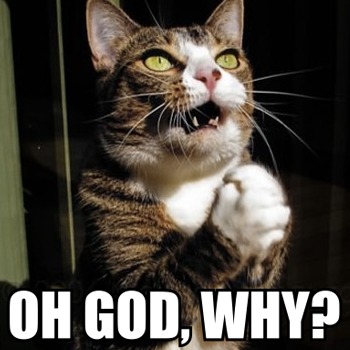
oh-god-why

After all, Product Management boils down to economics: the continuous assessment of wants (yours, your customers’, the market’s) against limited constraints (engineering capacity & time). If you have good quant at your fingertips – projected cost savings, potential revenue gain, improved KPIs  – well then, lucky you. Hard numbers make prioritization considerably easier – and upwardly defensible – and we should strive to obtain them before making any product decisions, big or small.
However, rarely do those beautiful metrics fall into our laps with a nice red bow on top. Typically we must do our homework and analyze the potential costs & benefits, which any good PM knows takes time. But, before you spend all that precious time and energy researching things that may or may not be worth it, simply ask yourself and the requester, “Why?” In fact, ask a few times. It won’t hurt.
Then resist the urge to be an order taker. Be like Liam. Ask why.